Free energy - make heating simpler, safer, more energy-saving and smarter! Freedom = autonomy/ego

Search

Which is better: finned module boiler or flat-stacked module boiler? Commercial full premix boiler s
2026-07-24 15:39
Which is better: finned module boiler or flat-stacked module boiler? Commercial fully premixed boiler selection guide
Main text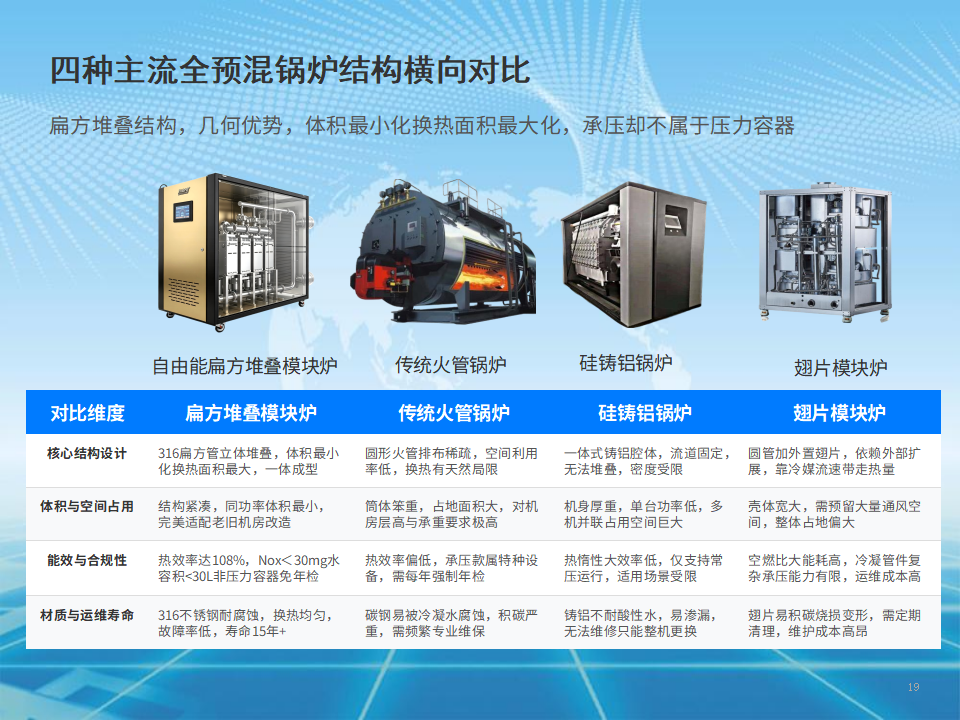
Finned tube module boilers are one of the mainstream fully premixed devices on the market, relying on external fins to expand the heat exchange area. However, the fin structure has inherent technical bottlenecks. Compared with the new-generationFree Energy flat-stacked module boiler, there are significant gaps in heat exchange efficiency, maintenance difficulty, and long-term stability, which is also the core reason why a large number of HVAC engineering contractors prioritize replacing finned tube boilers in renovation projects.
I. Heat exchange principle comparison: single-sided fin heat exchange VS flat double-sided three-dimensional stacked heat exchangeHeat exchange logic of finned module boiler: fins are added to the outside of the round tube, relying on external fins to expand the heat exchange area. This is a single-sided heat exchange mode, with uneven heat distribution and a tendency to form local high-temperature hot spots; the flue gas heat exchange path is short, and the waste heat recovery capacity is limited. The Free Energy flat-stacked structure features double-sided three-dimensional heat exchange, where hot and cold media exchange heat bidirectionally on both the inner and outer walls of the flat rectangular tubes. Relying on its unique geometric structure, the heat exchange area reaches 3\4 times that of finned tube boilers at the same volume, while the unit body size is reduced to 1/2\1/4 of traditional finned equipment; the ultra-long flue gas channel fully recovers condensing latent heat, achieving a comprehensive thermal efficiency of up to 108%, with low exhaust gas temperature and outstanding energy-saving performance.
II. Combustion system and daily operation and maintenance costsCommon finned module boilers on the market are generally equipped with burners that feature fine dust filter screens. During the autumn and winter heating season, dust and moisture can easily block the flame ports, requiring monthly disassembly for cleaning and maintenance, leading to continuously increasing labor maintenance costs. Local high temperatures also exacerbate carbon deposition and increased nitrogen oxide emissions. Free Energy is equipped with the industry-exclusiveflat wide-gap filterless fully premixed burner, which eliminates the fine filtration structure, making it less prone to dust accumulation and blockage. Only simple surface wiping is needed throughout the entire heating season, with no need for frequent disassembly. The low-temperature, uniform, flameless combustion suppresses thermal NOx at the source, stably achieving NOx < 30 mg/m³, with no need for later low-nitrogen retrofits.
III. Anti-scaling capability of water circuit structureFinned tube boilers have narrow heat exchange flow channels and weak water flow disturbance. In areas with high water hardness, scaling and blockage are highly likely to occur. Once blocked, the unit must be disassembled for deep cleaning, and shutdowns during the heating season or peak production periods directly cause business losses. The Free Energy flat-stacked large-diameter water circuit creates turbulent flow at high water velocity, making it difficult for scale to adhere and accumulate; it supports system chemical circulation for cleaning without disassembly, eliminating the need to shut down and dismantle the heat exchanger, making it suitable for long-term operation in laundries and high-hardness water areas.
IV. Energy consumption and long-term operational stabilityFinned module boilers have limited air-fuel ratio control capability, with turndown ratios mostly limited to 1:3~1:5, resulting in significantly increased energy consumption during low-load operation at night and in spring and autumn; fins are prone to ablation and deformation under prolonged high temperatures, and heat exchange efficiency continues to decline after years of use. Free Energy's self-developed electric gas valve adaptive closed-loop control system provides a 1:10 ultra-wide stepless load adjustment, maintaining high thermal efficiency even at low loads while automatically compensating for gas pressure and gas source calorific value fluctuations; the 316 stainless steel heat exchange unit is free from high-temperature ablation and deformation issues, with minimal efficiency degradation over years of operation. Its steam generators can be covered by agreements guaranteeing natural gas consumption of ≤75 m³ per ton of steam.
V. Machine room installation conditionsFinned module boilers have large casings and high burner oxygen consumption, requiring substantial ventilation space in the machine room, making retrofits in small basement machine rooms difficult. The Free Energy flat-stacked model has a compact structure, and the flat burner consumes less oxygen, so old sealed machine rooms do not require large-scale ventilation modifications, making it suitable for various renovation projects.
SummaryFor short-term, small-scale, low-frequency usage scenarios, finned module boilers have an initial purchase price advantage; for long-term operation projects such as hotels, schools, industrial parks, and factories requiring continuous heating, 24-hour hot water, and industrial steam, the Free Energy flat-stacked module boiler offers long-term value advantages in energy savings, maintenance convenience, and equipment service life, making it the preferred choice for heating season boiler upgrades and replacements.
Name:
Message:
Verification code: 
Submit
Comment

About us
Foshan Free Energy Electric Co., Ltd. was established in 2016 in Shunde, Foshan, Guangdong, and is a technology-based enterprise focusing on the in-depth research and development, production and sales of gas energy-saving thermal energy products.
Product classification
Contact us


contact us
电话
18038757576
QQ
453457997
微信
扫码咨询