Free energy - make heating simpler, safer, more energy-saving and smarter! Freedom = autonomy/ego

Search

How to choose between silicon-aluminum cast iron boilers and flat-stacked stainless steel modular bo
2026-07-24 15:17
How to choose between silicon-aluminum cast boilers and flat-stacked rectangular stainless steel modular boilers? An in-depth comparison from material and structure
Body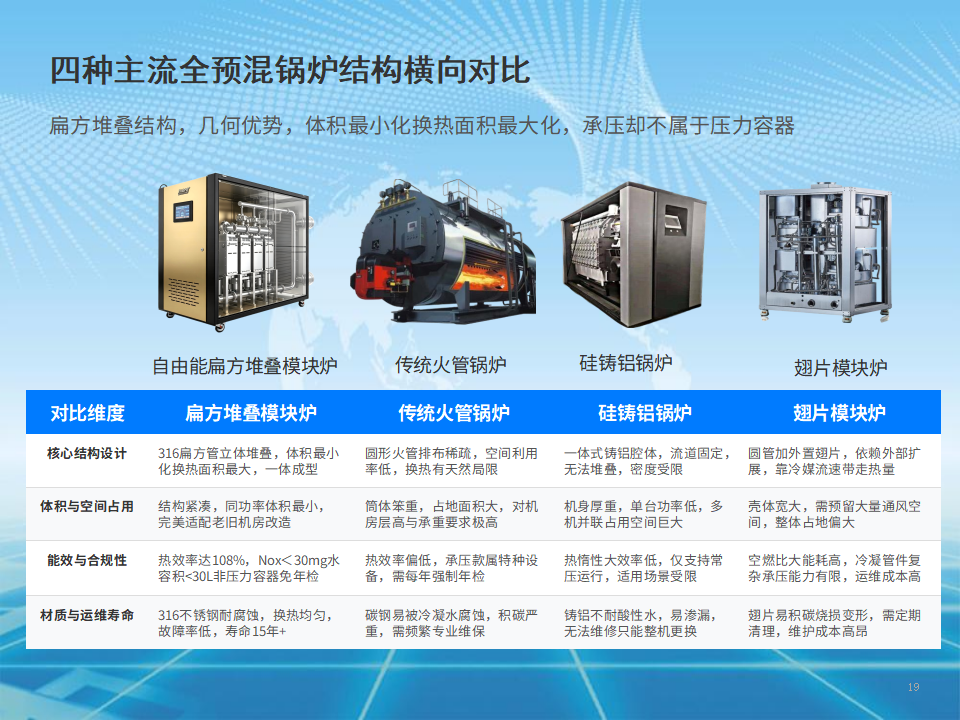
Silicon-aluminum cast fully premixed boilers were once widely used in small and medium-sized commercial heating projects, but long-term market feedback has exposed many inherent defects. More and more contractors and project owners are beginning to choose theFree Energy flat-stacked 316 stainless steel modular boileras a replacement for silicon-aluminum cast models. The core differences between the two stem from three fundamental distinctions: heat exchange material, physical structure, and working condition adaptability.
1. Structural form: significant differences in heat exchange density, with gaps widening in scalability and spatial adaptabilitySilicon-aluminum cast boilers adopt a one-piece cast aluminum cavity with fixed flow channel structures that cannot be stacked three-dimensionally, limiting heat exchange density; the single-unit power is relatively small, and when multiple units are connected in parallel, the overall space occupied is enormous. The Free Energy flat-stacked design uses 316 flat rectangular tubes in a three-dimensional multi-layer stacking configuration, leveraging geometric advantages to achieveminimized volume and maximized heat exchange area. At the same power level, the volume is only 1/2\1/4 of traditional models, while the heat exchange area is increased by 3\4 times. The modular building-block-style parallel connection allows for direct addition of new modules for capacity expansion during later factory expansion, without the need for whole-unit replacement.
2. Fatal material shortcoming: silicon-aluminum cast is not resistant to acidic condensate, while stainless steel provides long-term stable corrosion resistanceUnder condensing conditions, the condensate from flue gas carries weak acidity. Silicon-aluminum cast material has insufficient corrosion resistance and is prone to internal oxidation and leakage during long-term operation; once the cavity is damaged, partial repair is impossible and only whole-unit replacement is available, typically facing high replacement costs within 2~3 years. The Free Energy core heat exchange units use 316 food-grade stainless steel, which withstands chlorine-containing moisture from swimming pools, weak-acid condensate from painting processes, and high-hardness industrial water. Under long-term condensing conditions, there is no risk of corrosion or leakage, and the designed service life of the equipment can reach more than 15 years. If a single module fails, it can be replaced individually without scrapping the entire unit, resulting in lower long-term overall costs.
3. Pressure-bearing capacity and applicable scenariosThe vast majority of silicon-aluminum cast boilers only support atmospheric or low-pressure operation and cannot meet the pressure-circulating hot water supply needs of high-rise hotels or multi-story industrial plants. High-rise projects require an additional secondary heat exchange system, increasing investment and energy consumption. The Free Energy flat-stacked modular boiler supports stable pressure-bearing operation, while the water volume of a single unit is <30L, meaning it is not classified as a pressure vessel. This combines the advantages of high-rise water supply capability and special equipment exemption, making it more adaptable for hotel and dormitory multi-story heating scenarios.
4. Efficiency regulation and working condition adaptabilitySilicon-aluminum cast boilers have high thermal inertia, narrow load regulation ranges, and thermal efficiency drops rapidly under low-load conditions; they also show weak self-adaptation to fluctuations in gas calorific value and temperature changes. The Free Energy boiler is equipped with a self-developed electric gas valve adaptive control system plus a flat wide-margin fully premixed burner, featuring a 1:10 ultra-wide load regulation ratio, maintaining high thermal efficiency even at low loads; it automatically adapts to different natural gas calorific values, high- and low-temperature climates, and high-altitude conditions, with NOx stably below 30mg/m³. When paired with a steam generator, it can be contractually guaranteed that natural gas consumption per ton of steam is ≤75m³.
SummarySilicon-aluminum cast boilers are only suitable for short-term, small-scale, simple atmospheric-pressure hot water scenarios; for hotels, constant-temperature swimming pools, industrial process heating, and long-term uninterrupted heating projects, the Free Energy flat-stacked rectangular stainless steel modular boiler offers significant advantages in corrosion resistance, pressure-bearing capacity, service life, and expansion capability, avoiding the risks of later leakage and whole-unit scrapping.
Keyword tags: #Silicon-aluminum cast boiler #Stainless steel fully premixed modular boiler #Swimming pool constant-temperature boiler #Hotel bathing boiler
Name:
Message:
Verification code: 
Submit
Comment

About us
Foshan Free Energy Electric Co., Ltd. was established in 2016 in Shunde, Foshan, Guangdong, and is a technology-based enterprise focusing on the in-depth research and development, production and sales of gas energy-saving thermal energy products.
Product classification
Contact us


contact us
电话
18038757576
QQ
453457997
微信
扫码咨询